Staying safe in wildfire smoke
General
You may not consider all of the tips discussed to be appropriate for you. We all have different risk profiles and protection available to us. Some tips are better suited to heavier local smoke than you may be experiencing, while others are best utilized when a smoke event occurs alongside extreme heat.
In addition, any action you take which mitigates your risk is better than taking no action, regardless of its absolute efficacy. As you layer in more protective actions, your risk reduces overall - this has been called the “swiss cheese” defense model. So picking and choosing is reasonable! At the very least, please keep track of the AQI in your area. For the particulates it measures there is no safe level of exposure for anyone in any condition - all mitigation is helpful.
Understand the harm
Smoke - any smoke - is dangerous to breathe. The biggest danger comes from a class of particles we call PM2.5 - those which have a size of 2.5 microns or smaller. Pollutants in this range are difficult for the lungs to clear. They accumulate over time - all exposure increases your lifetime risk of lung disease, cancer, and chronic respiratory conditions such as COPD. PM2.5 pollution is measured with the Air Quality Index, or AQI - in general, everyone should be masking and limiting exposure when their local AQI is greater than 100 or so - fresh air typically rates in the 20s to 30s. Health effects can be noticeable at AQI levels as low as the 50s.
Environment and Climate Change Canada (ECCC) also uses the AQHI. This is a simplified scale which has gradations in risk exposure for levels from 1 to 10, but which can rise to much higher numbers to indicate the severity of air quality disasters - and wildfire smoke is a disaster.
Air pollution generally is linked to a large variety of chronic conditions which reduce your health and well-being. Protecting yourself and your loved ones from pollution is important - particularly for vulnerable groups, which include growing children, pregnant people, older adults, and people with heart and/or lung diseases. If you’re in one of these groups, or otherwise know yourself to be vulnerable to air quality issues, consider erring toward the more cautious end of these recommendations.
Tools to stay informed
The danger posed by smoke changes throughout the day, so timely information is important for decision-making. Online resources are great for this.
Purple Air
A map showing air quality monitoring stations around the world. The sensors shown are inexpensive and hosted by institutions, businesses, and random folks who are interested in surfacing this data. This map allows you to quickly see what the AQI is in your area.
Note that, by default, Purple Air doesn’t apply any weighted correction to the AQI each sensor displays. This means that measurements on Purple may show somewhat higher numbers than other resources. The US EPA publishes a correction formula that tends to reduce the AQI somewhat to better reflect what we know about the composition of wildfire smoke vs. what the sensor reads - this correction can be applied in the settings control in the top left of the map frame.
Purple also includes indoor air quality sensors by default, which aren’t useful if you aren’t in the same building. They are identified by a black circle around the sensor reading and can be disabled from the settings control.
FireSmoke.ca
A map which depicts large fires and smoke plumes in North America at present, as well as where they are expected to move in the near future. Even during a serious smoke event, the actual concentration of dangerous particles around you can change substantially throughout the day. Try to schedule your outdoor time for periods when the smoke is lighter.
airnow.gov
AirNow is the central online resource managed by the US government for air quality concerns. On its home page you can type any US location to get a spot report of the air quality there. There’s also links to helpful guides and other air quality resources.
fire.airnow.gov
The AirNow fire and smoke map, which shows both air quality readings and smoke plumes. The smoke layer is a lower resolution than FireSmoke.ca, but is generally useful. This map combines Purple Air’s sensor network with other networks and is somewhat more comprehensive. US EPA AQI correction is applied by default and the sensors which are shown have been vetted.
Other
Your phone’s weather app likely includes information on air quality. Many other apps are also available which make use of the same resources as tools listed above - your goal should be to find something that works for you that you can make a habit of checking while the smoke lingers.
Stay hydrated
You’ll need more water than normal to cope with the adverse conditions. Your lungs use water to make mucous, which is used to clear accumulated particles out. The sooner they can do this, the better.
You may feel sick
Smoke exposure leads to headaches, fatigue, anxiety, difficulty breathing, and many other symptoms. Those who suffer from allergies or asthma should expect these conditions to worsen while the smoke lingers. Everyone can be affected by smoke exposure, even individuals who consider themselves healthy.
When to seek medical help
If you or someone you know experiences chest pain, severe shortness of breath, confusion, or lips/face turning blue or gray, seek medical care immediately — call your doctor or emergency services. These can be signs of a life-threatening reaction to smoke exposure. If you have asthma and your rescue inhaler isn’t helping or you need it much more often than usual, treat this as an emergency too.
Even without these signs, if you experience symptoms which are persistent or which get worse despite taking precautions, it’s worth calling your doctor for guidance.
Don’t sweat the smell
Even with a well-fitting mask or portable respirator, you may find yourself smelling wildfire smoke. Many of the odors our noses can detect are too small to be reliably filtered - the static charge present on meltblown fabric masks (KN94, KN95, N95, etc) can prevent some smell intrusion but not all. Particles capable of making it through this kind of mask likely do not pose a risk to you.
Correspondingly, the air quality can be incredibly poor without any smell.
It isn’t just wood smoke
Wildfires quickly expand to consume everything in their path, including vehicles, homes, and other buildings. Burnt material joins the rest of the smoke. For this reason it’s much more dangerous than, say, being around a campfire. Wildfire smoke can even contain gases - e.g. carbon monoxide, volatile organic compounds, and formaldehyde - that can’t be filtered, which is another reason that limiting your exposure is so important.
Indoors
Keep windows closed!
The fewer particulates which enter your home, the better. While few buildings are truly air-tight, open windows enable significant air exchange. This may seem obvious to you, but too often folks fail to take this extremely important and simple precaution.
If you need fresh outdoor air - for example, because CO2 is accumulating - try your best to only allow it to come through a filter. Large furnace filters can be found at many stores or ordered online. Cover any gaps left on the window and seal all of the seams with painter’s tape, which can be easily removed without residue later. Check tape seams often, and prefer keeping the windows entirely closed when possible.
Block outdoor air
Doors and windows can be sealed off with painter’s tape if they aren’t in use. It is designed to come off easily after use, without damaging surfaces.
In heavy smoke, you can use soaked rolled-up towels to cover door thresholds.
Try not to run exhaust fans, such as those in bathrooms and kitchens, when it can be avoided. These cause your indoor space to have negative pressure relative to the outdoors, drawing in more outside air through cracks and crevices.
Filter your air
If your home (or apartment building) has a central air circulator (such as a furnace) which uses filters, find the best (highest MERV, ideally MERV13) filters which fit and which the HVAC blower is rated to handle, or get the super to do so. Then, run the circulator fan - most HVAC control panels allow you to do this without heating or cooling, though adding either to the mix is also fine. This will handle most of the burden for you.
Standalone HEPA-rated air purifiers are widely available. Anything which meets this standard will make an important difference in your indoor air. Purchase only from a reputable vendor - steer clear of third-party sellers on sites like Amazon and Walmart.
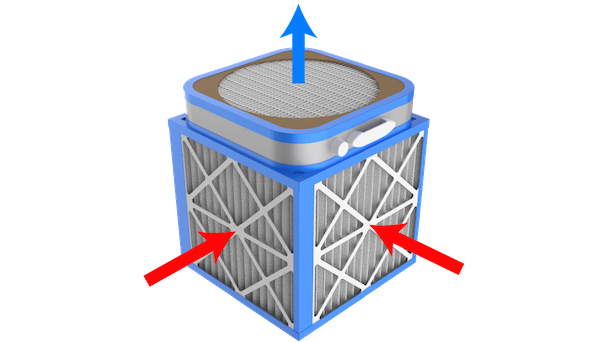
You can also make a DIY air purifier, also known as a Corsi-Rosenthal box: a relatively cheap (for its effectiveness) construction of furnace filters and a box fan which was popularized in the early pandemic. See below for a guide and links to further information. There are many designs with trade-offs in cost, clean air delivery rate (CADR), and space. The simplest iteration - a filter taped to the intake side of a fan - is still much better than nothing.
Monitor your air
Consider purchasing an air quality monitor to have an idea of how safe your interior air is. Some air purifiers have a basic monitor built-in, and use it to ramp the filtration up when particle loads are heavier. Others stand alone. Quality and calibration can vary pretty widely, but there are plenty of reputable brands.
I’d rather not link to any specific products, but I can say that I have used a monitor from Temptop for years with no issues. Airthings is also widely considered to be reputable. There are air quality monitors available that integrate with various smart home platforms, such as from IKEA.
Clean air shelters
If you can’t keep yourself reasonably safe at home, or need to leave it at times, look for clean air shelters in your community. Just like in extreme heat events, local governments often designate libraries or other municipal buildings as clean air shelters — they’re often equipped with better filtration than private homes and can offer a safe place to wait out heavy smoke. Check your local health department, emergency management agency, or municipal website for locations near you, or call a local emergency information line if one is available (such as 211 in the US and Canada).
Formal clean air shelter programs aren’t available everywhere. Even without one, a library, shopping mall, or other public building can still offer a decent place to get relief from smoke.
Outdoors
Wear a mask
Ideally, a fit-tested N95 or better. KN95s, KF94s, and similarly-rated masks are nearly as good - just be aware that ear loops can’t really guarantee the same seal as head loops. In a pinch, a cloth mask, a tightly-wrapped article of clothing, or any kind of physical barrier you can breathe through is better than nothing. It’s all about reducing exposure.
In particularly heavy smoke, fabric masks like those rated N95 may clog too quickly to be safe to use. If you find that it quickly becomes difficult to breathe through your mask, bring extras and swap them out as needed. Pay close attention to how you feel to be sure that you are getting enough air. In this situation it likely makes sense to acquire an elastomeric respirator (such as one rated P100) - these use multi-layer filters that are much more effective at tackling prolonged and heavy particle loads. They also form an excellent seal with your face, giving you peace of mind.
Limit activity and slow down
Exertion of any kind increases the amount of air your body needs to function. This correspondingly increases your exposure to the dangerous particulates in smoke. When the AQI rises above 150, you should avoid outdoor activity entirely. Whenever smoke is present, reduce outdoor exertion. Cut short your bike ride, abbreviate your dog walk, and do your best to limit the time you spend outside. The smoke will pass.
Plan for things to take longer. You may find yourself surprised by how quickly you feel out of breath, even during tasks that are usually easy for you. Take your time when walking or wheeling. Take breaks often. Try to stick to low-energy activities. Reduce your expectations - it’s okay if things feel hard to accomplish. Being inundated in smoke is a serious thing!
Keep pets safe
The air is as dangerous to them as it is to you, and they can’t take any action to protect themselves. Some dog owners have had luck with dog masks, but these should be used with caution because they can stop your dog from panting - their main way of keeping cool.
Cover up
If you must be outdoors, cover up. Long shirts and pants keep soot and ash away from your skin, where it can be an irritant. Glasses and goggles can protect your eyes. A hat will protect your head. Anti-inflammatories and antihistamines can both be useful for moderating the symptoms of smoke exposure. Definitely bring your inhaler along if you have one.
When you return home, change your clothes and collect the dirty clothes where they won’t get moved around (kicking up ash and soot) prior to cleaning. You can optionally keep clean damp washcloths in your fridge or freezer and use them to wipe down exposed skin on your limbs and face - it feels nice and it will clean you up.
Cleaning up later
Indoor surfaces
After the smoke has passed, if your home was heavily exposed, you should clean surfaces that may be harboring soot and ash. Carpets and soft furniture should be vacuumed with a machine which has a HEPA filter. Countertops, appliances, and hard furniture should be wiped down with a damp cloth - use a light touch to prevent the ash from causing scratches. Any lingering particles can become airborne again after settling, so undertaking this step saves you from future lung irritation. Cleaning up before the smoke has passed should be avoided - you’ll kick up ash when the air quality is already poor, and you’ll likely have to clean again after the smoke has passed.
Filters
All air filters should be inspected. If you experienced heavy soot, they will likely need to be replaced - soot and ash in your filter reduces its efficacy and can become dislodged later, posing a health risk all over again. This is true for air filters, HVAC filters, and even the air filters - engine and passenger - in your car.
Clothes and other fabrics
Your typical laundry practices will likely be sufficient to clean clothes and blankets that only received mild indoor exposure. If they were in outdoor air, or the smoke was particularly bad, they may need additional attention. There’s many ways to tackle this:
-
Use vinegar in place of fabric softener - up to a half cup per laundry load, either via the fabric softener dispenser (where the machine will dilute it as it uses it) or, in top-loading washers which don’t have a dispenser, directly into the drum during the rinse cycle, when it will immediately be diluted by the rinse water. Don’t add it to the detergent drawer and don’t add it during any other cycles - mixing vinegar with detergent causes both substances to perform poorly, and undiluted vinegar in contact with your fabrics can damage them.
-
A sprinkle of baking soda in the detergent dispenser (or added alongside the detergent to top-loading machines) boosts the power of the detergent and can help to remove odors.
-
OdorKlenz and similar products are widely appreciated as “last resort” smell removers. They can be even more effective with a pre-treatment soaking / laundry stripping phase.
With all additives, you may need to do an extra rinse cycle to clear lingering residue.
Outdoor surfaces
Outdoor surfaces you are responsible for may need to be cleaned, too - ash and soot contain alkaline compounds - often potassium-based from burned wood - that become caustic in the presence of water. A hard rain will generally clear out surface accumulations, but a soft rain, mist, or fog could cause concentrated ashy droplets to form that can substantially damage painted surfaces and clear coats. Hosing the surface down (or inundation with a bucket) generally takes care of this, because any resulting solution is too dilute to cause damage. Cars can be hosed down in a pinch, but it’s better to take them to a touchless car wash where the resulting pollution is captured rather than allowed to enter groundwater. Brush-style car washes can rub the ash into the clear coat and scratch it.